

An algorithm is a set of defined steps and rules designed to solve a specific problem or perform a predetermined task. In digital systems, algorithms perform various functions, such as processing, classifying, and comparing data, as well as generating results based on specific criteria.
Algorithms appear in different forms in everyday life. For example, the way a search engine ranks results for a query, how a social media platform determines which content to display to a user, or how a recommendation system presents new content based on previous behavior can all be considered examples of algorithmic processes.
However, algorithms should not be viewed solely as tools for performing technical operations. Algorithmic systems can influence which information becomes visible, which content is prioritized, and which options are presented to users. Therefore, algorithms constitute an invisible yet significant component of the digital information environment.
With the widespread adoption of digital technologies, the ways in which individuals access information have undergone significant transformation. Today, search engines, social media platforms, recommendation systems, and AI-powered applications play an active role in determining the information and content users encounter. A significant proportion of these systems rely on algorithmic processes to select, classify, prioritize, and present specific content from vast amounts of data. Consequently, the content encountered in digital information environments is shaped not only by users’ choices but also by algorithms that process these choices and generate results according to predefined rules. As the role of algorithms in accessing information continues to grow, users need to understand not only information sources but also the technological systems that facilitate access to these sources.
When a user conducts a search within a digital system, they typically encounter only the results displayed on the screen. However, various algorithmic processes take place before these results are generated. A simplified information retrieval process can be conceptualized as follows.
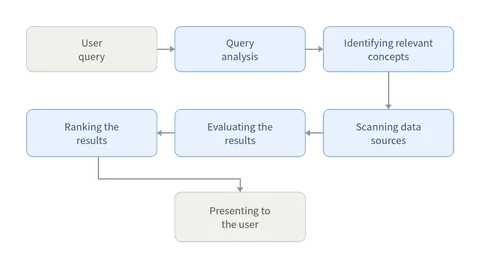
In this process, the system may not be limited to directly matching the user’s query. Depending on the technology used, the meaning of the query may be analyzed, related concepts may be identified, results may be ranked according to specific criteria, or data derived from the user’s previous behavior may be taken into consideration. Therefore, the list of results presented to the user is not simply a direct reflection of the available information sources. Rather, it should be understood as an output jointly shaped by data sources and algorithmic decision-making processes.
Algorithmic literacy refers to individuals’ ability to understand the basic principles underlying the algorithmic systems they encounter in their daily lives and to critically evaluate how these systems influence the decisions they make. Algorithmic literacy does not require individuals to develop algorithms or possess programming skills. Instead, it aims to foster awareness that algorithmic systems operate based on specific data, rules, and design choices, and to enable individuals to question the outcomes produced by these processes. In this context, algorithmic literacy is shaped around the following questions:
- Why does a system prioritize a particular result?
- What data and criteria does an algorithm use when making decisions?
- Which content becomes visible, and which content remains unseen?
- What factors influence the ranking of results?
- Could the results produced by algorithmic systems contain errors or biases?
- Can user behavior influence the system’s future decisions?
The primary aim of algorithmic literacy is to enable individuals to critically evaluate how and under what conditions the results produced by algorithmic systems emerge, rather than accepting these results without question.
Information literacy encompasses the skills required to identify information needs, access appropriate information sources, evaluate information, and use it ethically. However, as digital information environments have evolved, access to information increasingly takes place through algorithmic systems. Search engines, discovery systems, and AI-powered tools do not merely provide access to information sources; they also play a role in selecting, ranking, and presenting information to users. This situation adds a new dimension to traditional information literacy skills.
- Within the framework of traditional information literacy, the key questions are:
- Where can I access information?
- Is the source reliable?
- Is the information accurate and up to date?
Algorithmic literacy adds the following dimensions to these questions:
- Why did this information appear to me?
- From which sources did the system select?
- Which information was not made visible in the results?
- According to which criteria were the results ranked?
- How do algorithmic processes affect my access to information?
From this perspective, algorithmic literacy can be considered not an alternative to information literacy, but rather an important area of skills that complements it in digital and AI-powered information environments. Today, algorithms are not merely technical tools that facilitate finding information. They are also part of the decision-making mechanisms that influence how access to information takes place. The way an algorithmic system operates can affect:
- which sources are searched,
- which content is prioritized,
- how results are ranked,
- which information users encounter.
Therefore, critical thinking in digital information environments requires not only evaluating the content of information but also questioning the systems that make this information accessible to users. Algorithmic literacy helps users question the assumption that algorithmic systems are entirely objective or neutral. Every algorithmic system operates within the framework of specific data sources, technical choices, classification methods, and design decisions. Consequently, results generated by algorithms should not be regarded as absolute and immutable realities, but rather as outputs of specific systemic processes.
Understanding how information is made accessible is as important as accessing information itself.
Algorithmic literacy requires users to question not only the results they encounter on the screen but also the data, processes, and decision-making mechanisms behind those results. This inquiry has become increasingly important with the widespread adoption of AI-powered information retrieval systems. New-generation systems do not merely list information sources; they can interpret user queries, select relevant information, and generate responses by synthesizing information obtained from different sources. Therefore, algorithmic literacy should be regarded as an important component of critical and informed information use in today’s digital information ecosystem.
Information Centers have traditionally used various information retrieval systems to organize their print and electronic resources and make them accessible. Online Public Access Catalogs (OPACs) have enabled users to search the resources held in Information Center collections through bibliographic records. However, with the widespread adoption of electronic resources, the information retrieval environment has undergone significant change. In addition to books and periodicals, e-books, electronic journals, articles, databases, open access resources, and institutional repositories have also become part of Information Center collections. This diversity has created a fragmented information retrieval environment in which users need to search different systems separately. Information Center web discovery systems have been developed to integrate this fragmented structure as much as possible, enabling users to access different types of resources through a single interface.
An Information Center web discovery tool is an information retrieval system that brings together different information resources owned by or accessible through an Information Center within a common search environment. These systems generally enable users to discover various types of information resources through a single interface, including:
- print books,
- e-books,
- academic journal articles,
- periodicals,
- theses,
- institutional repository content,
- open access resources.
However, the primary function of discovery systems is not simply to bring resources together. They also manage information retrieval processes such as analyzing user queries, identifying relevant records, and ranking results according to specific criteria. Therefore, a web discovery system should not be regarded merely as a catalog or search box, but rather as a system that manages the information retrieval process between different data sources and the user.
In traditional information retrieval systems, users typically conduct searches using specific keywords. The system attempts to match the terms entered by the user with bibliographic records and indexed data.
- For example, when a user searches for "climate change and migration," the system may search for the relevant terms in titles, abstracts, subject headings, or other indexed fields.
However, users’ information needs cannot always be expressed using the most appropriate keywords. The same concept may be expressed using different terms across disciplines or sources. For example:
- climate change
- global warming
- climate crisis
- environmental change
These terms may be used as related concepts in different contexts.
Similarly, the terms "migration displacement," "human mobility," and "climate migration" may have different semantic relationships within the same research topic.
With the integration of artificial intelligence and natural language processing technologies into information retrieval systems, new approaches have emerged that evaluate user queries not only at the lexical level but also in terms of meaning and context. Information retrieval tool
Artificial intelligence technologies can be used at different stages of information retrieval processes. In particular, these technologies offer new possibilities for interpreting user queries and establishing connections with information resources through natural language processing, machine learning, and large language models. In an AI-powered information retrieval system, the process can generally consist of the following stages.
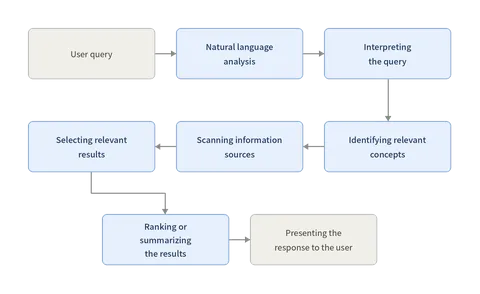
This approach differs significantly from traditional information retrieval systems. Instead of entering only a topic or keyword, users can now directly express their research questions using natural language.
For example, a question such as “How does artificial intelligence affect academic libraries?” can be analyzed by an AI-powered system, broken down into different concepts, and linked to relevant information resources.
The integration of artificial intelligence into Information Center discovery systems offers several potential advantages.
Natural Language Interaction: Users can express their research questions in natural language instead of creating complex Boolean queries.
Query Expansion: The system can identify terms related to the concepts used by the user and conduct a more comprehensive search.
Contextual Search: Searches can be based not only on keyword matching but also on semantic relationships between concepts.
Information Synthesis: AI can bring together information obtained from different sources and provide users with a summary-style response.
Support for the Research Process: AI can help users establish a starting point for their research topics and discover relevant resources more quickly. However, these advantages do not mean that the results generated by AI-powered systems should be accepted without scrutiny.
Information Center discovery systems facilitate access between users and information resources. However, this facilitation is neither neutral nor entirely invisible. The following aspects of a system can directly affect users’ experience of accessing information:
- which data sources it indexes,
- which metadata fields it uses,
- how it interprets queries,
- according to which criteria it ranks results,
- which resources it considers more relevant.
With the integration of artificial intelligence technologies into these systems, algorithmic facilitation is becoming more complex. A system may not simply rank existing records; it may also reinterpret the user’s query, establish relationships between concepts, and generate new text by synthesizing information obtained from different sources. At this point, the fundamental issue for users is not only what the system presents, but also how the presented result is produced.
Primo VE is a discovery tool developed by Ex Libris and currently part of the Clarivate product portfolio. The system enables users to discover a knowledge center’s physical and digital resources through a common interface. The information resources of a knowledge center may be located across different systems and infrastructures. For example, a user may access:
- print books,
- e-books,
- academic journal articles,
- databases,
- digital collections,
- institutional repository content,
- open access resources through different platforms.
One of the primary functions of Primo VE is to provide users with a centralized discovery point within this fragmented information environment. However, the system does not simply display different resources through a single interface; it also plays a role in processing user queries, identifying relevant records, and pres
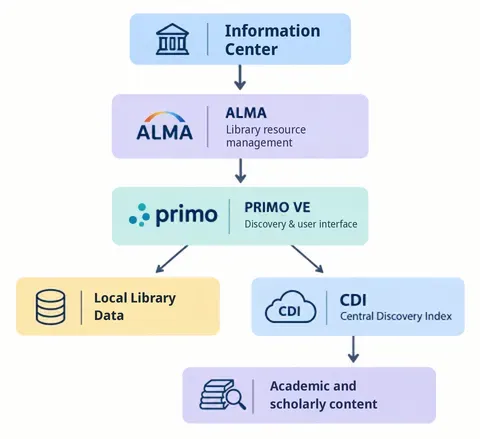
A search conducted in Primo VE may include different groups of resources depending on the search scope configured by the user. For example, different search scopes can be defined within the system:
- only the institution’s local collection,
- content available through the Central Discovery Index,
- a combined search of the local collection and the central index,
- resources from other institutions participating in collaborative networks.
In its default configurations, Primo VE includes different search profiles, such as IC Catalog and Search Everything.
Primo VE’s information retrieval architecture can generally be considered in terms of two primary source areas.
1. Local Library Data: This includes resources that are directly held in or managed by the institution’s collection. Examples include print books, electronic resources, digital collections, institutional repository records, and locally created bibliographic records. Data related to these resources are transferred to Primo VE from the library’s own systems.
2. Central Discovery Index (CDI): The second key component is CDI. CDI is a centralized and unified academic content index developed by Ex Libris to support discovery systems such as Primo and Summon. CDI brings together a wide range of academic content provided by different sources, including publishers, aggregators, and open access repositories. CDI may contain various types of academic materials, including journal articles, e-books, book chapters, conference proceedings, newspaper content, and open access resources. While CDI primarily operates on metadata, full-text indexing is also available for some content.
Understanding the role of CDI is important for understanding the scope of a search conducted through Primo VE. For example, suppose a researcher asks the following question:
- How does artificial intelligence affect academic libraries?
If this query is searched only within the information center’s catalog records, the results may be limited. However, when the search is conducted across a broad central index such as CDI, academic records from different publishers and content providers are also included in the search process.
One of the primary functions of CDI is to bring together metadata records for academic content available across different platforms within a centralized discovery environment. However, an important distinction should be made here:
Indexing ≠ Full-Text Access
The indexing of a resource in CDI does not mean that every user can access its full text. A user’s ability to access the full text depends on factors such as the institution’s subscriptions, licensing agreements, the resource’s open access status, and the access conditions established by the content provider. Therefore, the ability of a web discovery tool to search across a broad index and a user’s ability to access every resource found through that search are not the same thing.
From the user’s perspective, the process in Primo VE appears quite simple: a query is entered into the search box, and the results are displayed. However, a more complex information retrieval process takes place in the background. This process can be simplified as follows:
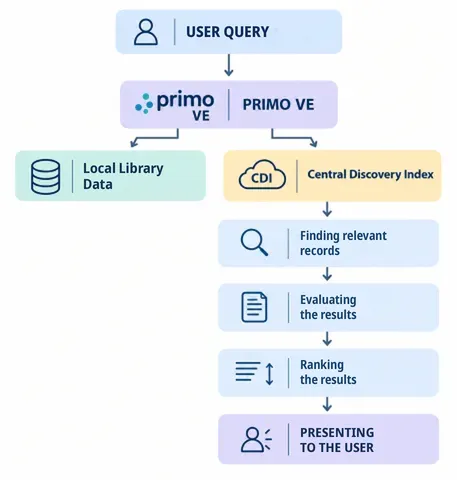
In this process, users see only the results screen. However, multiple system-level processes can influence how these results are generated, including:
- which data sources are searched,
- which records are matched to the query,
- how different records representing the same content are merged,
- which results are considered more relevant,
- and according to which criteria the results are ranked.
CDI also uses mechanisms to deduplicate and merge data relating to identical or similar records from different sources. This helps reduce the number of duplicate results that users encounter for the same academic record.
From a user experience perspective, Primo VE may offer an interface similar to general-purpose search engines. However, it differs from general web search engines such as Google in terms of its context and data sources. While general web search engines attempt to index content available across the web, Primo VE primarily operates on resources managed by or accessible through the library, as well as academic content available through CDI. Therefore, the results users encounter in Primo VE are not a reflection of all information available on the Internet, but rather of the information resources that the system can access and index.
This distinction is critical from the perspective of algorithmic literacy. When evaluating the quality of a result produced by a system, it is important to consider not only how the algorithm operates, but also the data sources on which the algorithm operates.
The primary purpose of Primo VE is to enable users to discover information resources. However, this process is not simply a passive act of listing records. The system processes user queries through specific search mechanisms and presents the resulting records according to various criteria. For example, the search process may be influenced by factors such as:
- query terms,
- metadata fields,
- resource type,
- availability,
- search scope,
- the ranking of relevant results.
Therefore, the list of results displayed on a user’s screen is not simply a random list of available resources. Results are generated through specific information retrieval and ranking mechanisms.
At this point, a fundamental question from the perspective of algorithmic literacy arises again: Is the resource displayed at the top of a results list necessarily the best resource, or is it the resource made most visible by the system according to specific criteria? This question becomes increasingly important, particularly as AI-powered tools are incorporated into discovery systems.
The traditional function of Primo VE is to enable users to search across a broad information landscape and discover relevant resources. However, with the introduction of new AI-powered tools, this process is evolving to a different stage.
In the traditional model:
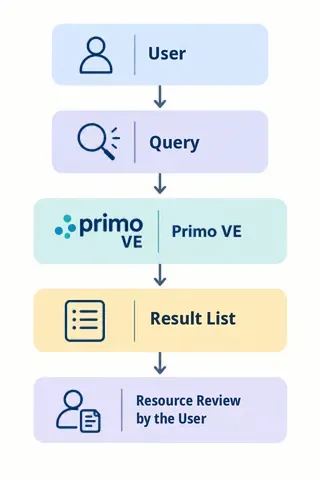
In the AI-powered model, the process expands as follows:
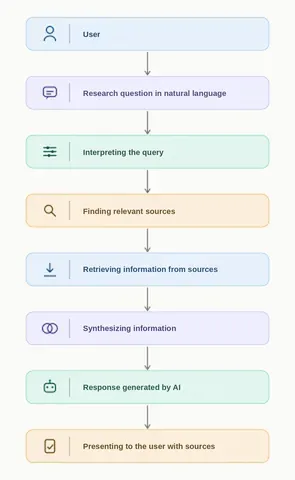
This transformation is changing the role of web discovery tools. The system is evolving from being merely a tool that “finds resources” toward a structure that “helps generate answers to research questions” based on specific sources. The AI-powered component of Primo VE within this transformation is Primo Research Assistant.
Primo Research Assistant is a generative AI-powered research tool integrated into Primo VE. In addition to traditional keyword searches, it aims to enable users to explore academic resources by expressing their research questions in natural language. The system analyzes the user’s question, identifies relevant resources within the Central Discovery Index (CDI), and generates a sourced response using the selected resources. In this respect, Primo Research Assistant expands the traditional Query – Results List model found in discovery systems toward a Research Question – Identification of Sources – Synthesis of Information – Sourced Response model.
Research Assistant was developed by Ex Libris to support the use of generative AI in the discovery systems of Information Centers. The tool was first made available to selected institutions in June 2024 as part of a beta program. During the beta phase, the system’s functions were evaluated based on feedback from universities and research institutions in different countries. Made available to Primo institutions in September 2024, Primo Research Assistant has become a new component of the Primo discovery environment through its approach of responding to research questions in natural language, identifying relevant academic resources, and generating summarized responses based on those sources.
The primary purpose of Primo Research Assistant is not to conduct research on behalf of the researcher. The tool is intended to support users, particularly at the initial stage of the research process, by providing a general framework on a topic and helping them discover relevant academic resources. Therefore, it is important to evaluate the responses generated by the system not as a final source of information, but as a starting point for research that directs users to relevant sources.
With Primo Research Assistant, the web discovery tool is evolving from a structure that merely lists resources into one that selects resources and presents users with new text generated using those resources. This raises new questions from the perspective of algorithmic literacy: Which sources does the system select? Why are some sources prioritized over others? How is information from the sources synthesized? To what extent does the generated response accurately represent the sources? These questions make it necessary to understand the technical workings of Primo Research Assistant.
Primo Research Assistant does not generate responses to users’ questions based solely on the existing knowledge of a large language model. Instead, it incorporates relevant academic resources into the research process by using an approach known as Retrieval-Augmented Generation (RAG). The RAG approach consists of two main stages:
1. Retrieval (Retrieving Information): The user’s research question is analyzed, and relevant academic resources are searched within the Central Discovery Index (CDI).
2. Generation (Generating the Response): Information obtained from the identified sources is processed by the large language model to generate a response for the user in natural language.
The primary purpose of this approach is to ground AI-generated responses in specific academic sources. However, an important point should be noted: the RAG architecture does not completely eliminate the possibility of errors by AI. The quality of the response depends on the sources accessible to the system, the relevance of the documents selected, and how the large language model interprets this information. Therefore, RAG links the AI-generated response to sources; however, it does not eliminate the need to critically evaluate the generated response.
To illustrate how the Primo AI Research Assistant works, let us examine the research question, “What are the effects of climate change on migration?” This example demonstrates that although the user submits only a single question to the system, multiple algorithmic processes take place in the background.
The user asks the following question in natural language: “What are the effects of climate change on migration?” At this stage, the user does not need to specify Boolean operators, synonyms, or academic keywords.

Rather than searching for the question exactly as entered, Research Assistant expands it using different concepts and expressions. For example, the generated query includes different expressions such as:
- climate change migration effects
- impact of climate change on migration
- human migration
- environmental migration
- population displacement
- iklim değişikliği
- göç
- göç etkileri
Boolean operators such as OR and AND are also used within the query. This stage is particularly important from the perspective of algorithmic literacy. Although the user has asked only a single question, the system changes the scope of the search by determining which concepts are related and which alternative expressions should be searched. The question entered by the user and the search conducted by the system are not the same thing.
In the example, the query generated by the system is quite broad:
- (climate change migration effects) OR (impact of climate change on migration) OR ((climate change) AND (human migration)) OR ((climate change) OR (environmental migration)) OR (effects of climate change on population displacement) OR (iklim değişikliği göç etkileri) OR (iklim değişikliği) OR (göç nedenleri) OR ((iklim değişikliği) OR (göç)) OR ((iklim değişikliği) AND (göç etkileri)) OR (İklim değişikliğinin göç üzerindeki etkileri nelerdir?)

This query enables a much broader search than a single keyword search. However, a critical question arises for the user: Did the system establish the correct conceptual relationships while expanding the query? For example, relating the concepts of “climate change” and “migration” with OR in some parts of the query may considerably broaden the search scope. Therefore, while algorithmic query expansion can increase the number of results, it may also cause content that is not directly related to the topic to be included in the results.
The generated query is run against the Central Discovery Index (CDI). Based on the results of this search, the system identifies the academic sources it considers relevant. In the example, the five selected sources are:
- İklim Değişikliğine Bağlı Su Kıtlığı ve Zorunlu Göç: Türkiye’nin Güneydoğusunda Suriyeli Kadın Göçmenlerin Kırılganlıkları — Baykal, 2026
- İklim Değişikliği ve Göç: Oğuzların Mâverâünnehir ve İran’a Göçleri — Küçükbekir et al., 2024
- İklim değişikliği konferansları sonuç belgelerinin göç bağlamında analizi — Çelikyay et al., 2026
- İklim Göçünün Anlatılarını İnşa Etmek: Türk Haber Medyasında İklim Değişikliği ve Göç Söyleminin Analizi — Pazarbaşı, 2024
- İklim Değişikliğine Bağlı Göçlerin Kadınlar Üzerindeki Etkileri — Karaman et al., 2025
An important point to note here is that not all sources available in CDI are used in the generated response. The system selects specific sources to generate the response.

Research Assistant then brings together the information obtained from the sources it has selected. In the example, the five sources present different perspectives:
- Baykal (2026): Water scarcity and forced migration
- Küçükbekir et al. (2024): Historical and environmental factors
- Çelikyay et al. (2026): International policy
- Pazarbaşı (2024): Media and public perception
- Karaman et al. (2025): Gender
This demonstrates that the algorithm does not merely “find sources”; it also performs a process of source selection and representation in relation to the research question. For example, if a different set of five sources had been selected, the topics emphasized in the generated response could also have been different.
The information obtained from the selected sources is processed by AI to create an “Overview of sources.” In the example below, the system brings together different themes, such as:
- water scarcity,
- drought,
- agricultural productivity,
- economic conditions,
- gender,
- migration policies,
- media representations,
to produce a comprehensive explanation.
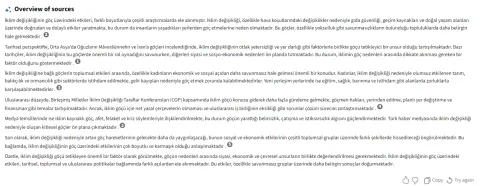
The resulting text is not simply a sequence of the five articles presented one after another. AI summarizes and synthesizes the information obtained from the sources to create a new narrative. Therefore, an important question for the user is: “Does this statement actually appear in the source, or is it an interpretation derived by the AI from the sources?”
In the example, the system not only generates a response but also suggests new research questions:
- What are the latest studies on the relationship between climate change and migration?
- How do the effects of climate change on migration from rural to urban areas manifest themselves?
- What are the socioeconomic conditions of communities that have been forcibly displaced due to climate change?
- What are the effects of climate change on migration policies and governance?
This feature demonstrates another dimension of algorithmic facilitation. The system does not only generate an answer to the question “What should I answer to the question?” but also generates possibilities in response to the question “What can the user research next?” Consequently, AI-powered discovery systems can also influence the direction of the user’s research process.

Based on this single example, the user can ask the following questions:
- Query: How did the system interpret my question, and which terms did it add?
- Scope: Which sources did it search, and which were excluded from the search?
- Selection: Why were these five particular sources selected?
- Synthesis: Did the AI accurately represent the information in the sources?
- Visibility: Could there be different or contradictory information in the sources that were not selected?
- Further Research: Do the research questions suggested by the system influence the direction of my research?
In this example, the user asked only a single question. However, in response, an algorithmic process took place involving query expansion, Boolean query formulation, CDI search, source selection, information synthesis, response generation, and the suggestion of new research questions. Algorithmic literacy helps make this process visible and enables users to ask “why?” at each stage.
Primo AI Research Assistant is not a system that searches the entire Internet or all records available in Primo VE. It primarily generates its responses from the metadata and abstracts of records within the Central Discovery Index (CDI). Therefore, the response generated by the system is directly related to the scope of CDI and the participation of content providers.
The system uses academic content available in CDI that has sufficient metadata and abstracts. However, some content is excluded from the scope of Primo AI Research Assistant:
- News content,
- Sources without sufficient metadata or abstracts,
- Retracted or withdrawn documents,
- Some subscription-based A&I collections,
- Content from DataCite, Elsevier, and JSTOR, as well as some aggregated content from these providers.
These exceptions may change over time; Clarivate indicates that the scope may be updated depending on discussions with content providers.
Reliability of Primo AI Research Assistant
Although Primo AI Research Assistant attempts to ground its responses in sources and indicate the sources used, the generated response is not itself a direct academic source. The response is generated by AI based on the abstracts of the selected sources. Therefore, users should ask not only, “Is this response accurate?” but also, “Which sources and what content scope does this response rely on?” This is one of the fundamental points of algorithmic literacy: the fact that a system provides citations does not automatically mean that the interpretation it generates is accurate.
In AI-powered discovery systems, it is important to understand not only how information resources are processed, but also how user data are handled. When using Primo Research Assistant, understanding how queries and interactions with the system are processed is an important part of algorithmic literacy. The use of AI by the system does not mean that users’ personal information or research history is used without limitations. Nevertheless, it is important for users to review the data processing, storage, and privacy policies of the platform they use.
AI-generated research responses:
- Do not replace the sources themselves.
- May contain inaccurate or incomplete information.
- Are limited by the scope and selection of the sources used.
- Should not be the sole basis for academic decisions.
Therefore, users should verify the generated response by consulting the relevant sources and, particularly in academic research, should examine the primary source.
Trusting AI does not mean failing to question AI.
An algorithmically literate user asks not only, “What did the system answer?” but also, “What data, sources, and processes were used to generate this response?”